Mist Eliminator for Polysilicon and Semiconductor Manufacturing: Zero-Tolerance Submicron Capture
Polysilicon production and semiconductor fabrication represent the most demanding mist elimination applications in the chemical industry. The performance requirements are not measured in percentage points — they are measured in parts per billion. A single mist carryover event that would be acceptable in a fertilizer plant can contaminate an entire semiconductor fabrication batch worth millions of dollars.
Filtearth designs and manufactures fiber bed mist eliminators for polysilicon and semiconductor applications — where outlet mist concentrations must reach single-digit mg/Nm³ levels and collection efficiency requirements approach 99.99% for the finest aerosol fractions.
The Polysilicon Production Challenge
Siemens Process: Trichlorosilane and Hydrogen Chloride
The majority of electronic-grade polysilicon is produced by the Siemens process, in which trichlorosilane (TCS, SiHCl₃) is thermally decomposed in a chemical vapor deposition (CVD) reactor to deposit purified silicon on heated rods. The tail gas leaving the CVD reactor contains:
- Unreacted trichlorosilane (SiHCl₃)
- Silicon tetrachloride (SiCl₄) — a byproduct of the deposition reaction
- Hydrogen chloride (HCl)
- Hydrogen (H₂) carrier gas
- Fine liquid aerosols of chlorosilane compounds
These components must be separated and recovered before the tail gas enters the cold trap or hydrochlorination recovery circuit. Inadequate mist elimination compromises trichlorosilane purity in the recovery circuit, contaminates hydrochlorination catalysts, and reduces overall silicon yield — directly impacting production economics at a process where raw material costs dominate.
Fluidized Bed Reactor Process
An alternative polysilicon production route uses fluidized bed reactors (FBR) with silane (SiH₄) or trichlorosilane as the silicon source. FBR off-gas contains silicon dust, fine droplets of chlorosilane compounds, and hydrogen. The combination of reactive silicon dust and chlorosilane mist creates a particularly challenging environment for mist elimination equipment — requiring both chemical resistance and solid-tolerant fiber design.
The Purity Requirement
Electronic-grade polysilicon must meet metal contamination specifications measured in parts per trillion. Any contamination introduced by mist eliminator materials — through fiber degradation, screen corrosion, or shell material leaching — directly impacts polysilicon quality and customer acceptance. Material selection for polysilicon mist eliminators is therefore governed not just by corrosion resistance but by contamination potential.
The Semiconductor Fabrication Challenge
Wet Etching Exhaust Streams
Semiconductor wafer fabrication uses hydrofluoric acid, hydrochloric acid, sulfuric acid, nitric acid, and mixed acid solutions for etching, cleaning, and surface preparation. The exhaust systems handling acid vapor and mist from wet bench stations must achieve outlet mist concentrations in the single-digit mg/Nm³ range to meet cleanroom air quality standards and environmental discharge limits.
Acid Vapor Scrubber Outlets
Wet scrubbers used to treat semiconductor fabrication exhaust generate their own mist — fine droplets of scrubbing liquid that must be removed from the treated gas before discharge. Scrubber outlet mist eliminators for semiconductor exhaust service must handle a complex mixture of dilute acids and achieve very low outlet concentrations to meet environmental permits.
Cleanroom Exhaust Treatment
Cleanroom exhaust contains trace concentrations of process chemicals — solvents, acids, and specialty gases used in photolithography, deposition, and etching processes. Mist eliminators in cleanroom exhaust service must achieve near-complete removal of all liquid aerosols to prevent re-entrainment into makeup air systems.
Why Standard Fiber Bed Designs Are Insufficient
Standard fiber bed mist eliminators designed for industrial acid mist service — sulfuric acid plants, chlor-alkali facilities — are optimized for removal efficiency targets of 99.96% with outlet concentrations below 5 mg/Nm³. For most industrial applications, this performance level provides reliable emission compliance and equipment protection.
Polysilicon and semiconductor applications impose fundamentally more stringent requirements:
Higher efficiency target: Outlet concentrations of 1 to 5 mg/Nm³ are not sufficient for polysilicon tail gas recovery circuits. Contamination of the trichlorosilane recovery system degrades product quality and catalyst performance. Mist eliminators for this service must achieve outlet concentrations below 1 mg/Nm³ for the finest chlorosilane aerosol fractions.
Zero contamination tolerance: Standard fiber bed elements use glass fiber or carbon fiber construction. For polysilicon and semiconductor service, any metallic contamination from fiber, screen, or shell materials is unacceptable. Material selection must prioritize contamination-free construction as well as chemical resistance.
Reactive gas environment: Chlorosilane compounds react with moisture to produce HCl and silicon oxide. Mist eliminator materials must resist both the chlorosilane compounds and their hydrolysis products. Any moisture ingress into the fiber bed accelerates material degradation and introduces contamination risk.
Filtearth Engineering Solution for Polysilicon Service
Filtearth Proprietary Glass Fiber for Chlorosilane Service
Filtearth proprietary glass fiber provides the combination of chemical resistance and contamination-free construction required for polysilicon tail gas mist elimination:
- Chlorosilane resistance: Stable in contact with trichlorosilane, silicon tetrachloride, and hydrogen chloride at operating temperatures and concentrations encountered in Siemens process tail gas
- Low contamination potential: Proprietary glass fiber formulation minimizes metallic contamination risk in high-purity process service
- Fine fiber diameter: 3 to 8 micron fiber diameter for maximum Brownian diffusion efficiency in the submicron size range characteristic of chlorosilane aerosols
- High packing density: Optimized for outlet concentrations below 1 mg/Nm³
Design Configuration for Polysilicon Tail Gas
The mist eliminator configuration for Siemens process tail gas service is engineered around three requirements: submicron collection efficiency, contamination control, and resistance to chlorosilane hydrolysis products.
Inert atmosphere design: The fiber bed vessel is designed for inert gas purging to prevent moisture contact with chlorosilane-wetted surfaces during startup, shutdown, and maintenance. This eliminates HCl generation from chlorosilane hydrolysis inside the vessel and prevents silicon oxide deposition on fiber surfaces.
High-efficiency fiber packing: Fine proprietary glass fiber with optimized packing density achieves the sub-1 mg/Nm³ outlet concentration required for trichlorosilane recovery circuit protection.
Low face velocity design: Operating at reduced superficial velocity maximizes Brownian diffusion residence time for submicron chlorosilane aerosols — the dominant collection mechanism at this particle size.
Contamination-controlled materials: All wetted components — fiber, screens, end plates, and vessel internals — are specified from materials validated for high-purity process service.
Design Configuration for Semiconductor Exhaust Service
Semiconductor wet bench and scrubber outlet mist eliminators operate in a chemically complex but lower-purity environment than polysilicon tail gas service. The design priorities shift toward:
Multi-acid resistance: The fiber and shell materials must resist simultaneous exposure to HF, HCl, H₂SO₄, HNO₃, and mixed acid combinations used in semiconductor cleaning processes. Filtearth proprietary glass fiber provides broad-spectrum acid resistance for mixed acid exhaust service.
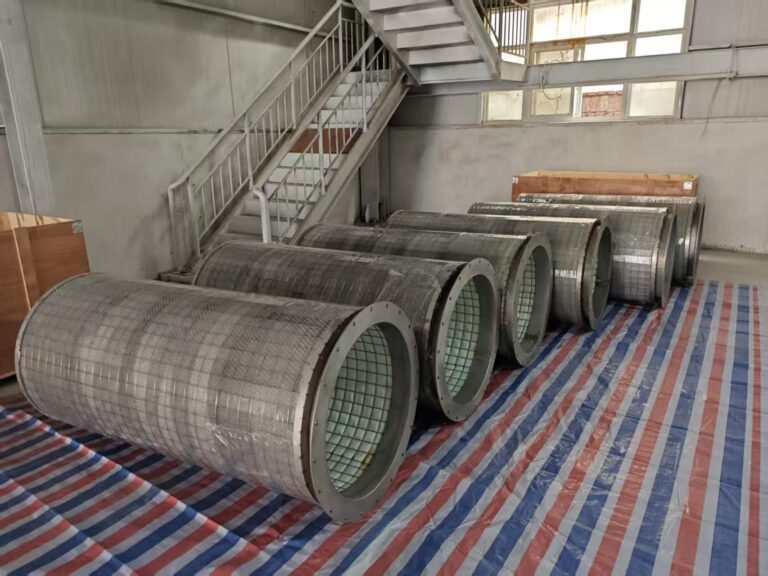
High flow rate capability: Semiconductor fabrication exhaust systems handle large gas volumes from multiple process tools simultaneously. Fiber bed elements up to 1,500 mm diameter accommodate high flow rates within compact vessel configurations.
Consistent outlet performance: Cleanroom air quality standards require consistent mist elimination performance across variable exhaust flow rates as individual process tools cycle through active and idle states. Fiber bed technology provides stable efficiency across a wide operating velocity range.
Material Specifications for Polysilicon and Semiconductor Service
Polysilicon Tail Gas Service
| Component | Specification | Reason |
|---|---|---|
| Fiber medium | Filtearth proprietary glass fiber (fine grade) | Chlorosilane resistance, low contamination potential |
| Inner and outer screens | Electropolished SS316L | Cleanroom-compatible, HCl resistant |
| Vessel shell | SS316L or Hastelloy C-276 | Chlorosilane and HCl resistance |
| End plates | SS316L | Matched to vessel material |
| Connection standard | ANSI 150# or 300# | Standard for process plant connections |
| Inert purge connection | Required | Prevents moisture contact during offline periods |
Semiconductor Exhaust Service
| Component | Specification | Reason |
|---|---|---|
| Fiber medium | Filtearth proprietary glass fiber | Multi-acid resistance |
| Inner and outer screens | PP or PVDF | HF and mixed acid resistance |
| Vessel shell | PP, FRP, or PVDF-lined FRP | HF resistance at ambient to moderate temperature |
| Connection standard | ANSI or JIS | Per facility specification |
Operating Specifications
| Parameter | Polysilicon Service | Semiconductor Exhaust |
|---|---|---|
| Fiber material | Filtearth proprietary glass fiber (fine) | Filtearth proprietary glass fiber |
| Collection efficiency | > 99.96% | 99.96% |
| Target outlet concentration | < 1 mg/Nm³ | < 5 mg/Nm³ |
| Droplet capture range | 0.1–3 μm | 0.1–3 μm |
| Operating temperature | -20°C to 80°C | Ambient to 60°C |
| Element diameter range | 200–1,500 mm | 200–1,500 mm |
Operational and Economic Benefits
Trichlorosilane Recovery Protection
The economic justification for high-performance mist elimination in Siemens process polysilicon plants is direct: every kilogram of trichlorosilane that passes the mist eliminator and enters the cold trap or hydrochlorination circuit as liquid aerosol represents recoverable silicon feedstock that is either lost or returned at degraded purity.
At polysilicon production economics where trichlorosilane accounts for a substantial fraction of variable production cost, reducing tail gas mist carryover from 10 mg/Nm³ to below 1 mg/Nm³ generates measurable yield improvement across the full production campaign.
Hydrochlorination Catalyst Protection
Chlorosilane mist carryover into the hydrochlorination reactor contaminates the catalyst bed over time, reducing conversion efficiency and requiring more frequent catalyst replacement. Proper mist elimination upstream of the hydrochlorination circuit extends catalyst service life and reduces the frequency of reactor downtime for catalyst changeout.
Compressor and Heat Exchanger Protection
Chlorosilane liquid carryover into tail gas compressors causes seal degradation and bearing contamination. Liquid carryover into heat exchangers promotes fouling and corrosion. Both failure modes result in unplanned downtime in a process where continuous operation is essential to production economics.
Frequently Asked Questions
What fiber material does Filtearth use for polysilicon tail gas mist eliminators? Filtearth uses proprietary glass fiber in fine-diameter grades (3 to 8 microns) for polysilicon tail gas service. The fiber formulation is selected for chlorosilane chemical resistance and low contamination potential, providing the combination of collection efficiency and material purity required for Siemens process tail gas applications.
Can Filtearth supply mist eliminators for both Siemens process and fluidized bed reactor polysilicon plants? Yes. Siemens process tail gas service uses fine proprietary glass fiber optimized for submicron chlorosilane aerosol capture. Fluidized bed reactor off-gas service, which contains silicon dust in addition to chlorosilane mist, requires a coarser fiber grade with higher solids tolerance and typically a pre-separator upstream of the fiber bed. Filtearth engineers the appropriate configuration for each production route.
What outlet mist concentration can Filtearth units achieve in polysilicon service? Filtearth fiber bed mist eliminators for polysilicon tail gas service are designed to achieve outlet concentrations below 1 mg/Nm³ for chlorosilane aerosols in the 0.1 to 3 micron range. Actual outlet concentration depends on inlet loading, operating velocity, and fiber bed specification — all of which are determined from your process data during engineering design.
How is moisture ingress prevented in chlorosilane service? Filtearth designs polysilicon tail gas mist eliminators with inert gas purge connections for nitrogen blanketing during offline periods. This prevents moisture contact with chlorosilane-wetted fiber and vessel surfaces, eliminating HCl generation from hydrolysis and silicon oxide deposition on fiber surfaces during shutdown and maintenance.
What is the service life of the fiber bed element in chlorosilane service? In clean Siemens process tail gas service with no solid contamination, proprietary glass fiber elements typically achieve 3 to 5 years of service life. In fluidized bed reactor service with silicon dust loading, element life depends on solid loading and upstream pre-separation effectiveness.
Can Filtearth supply mist eliminators for semiconductor wet bench exhaust? Yes. Filtearth supplies fiber bed mist eliminators for semiconductor fabrication exhaust service, including wet bench exhaust, acid vapor scrubber outlets, and cleanroom exhaust treatment. The fiber and shell material specification is selected based on the acid composition of your specific exhaust stream.
Request a Technical Quotation
If you are evaluating mist eliminators for polysilicon tail gas, semiconductor wet bench exhaust, or acid vapor scrubber outlet service, Filtearth is ready to provide a detailed technical proposal within 24 hours.
To receive a quotation, please provide:
- Production process (Siemens CVD, fluidized bed reactor, semiconductor wet bench)
- Gas composition (chlorosilane species, HCl concentration, H₂ content)
- Gas flow rate (m³/h or Nm³/h)
- Operating temperature and pressure
- Required outlet mist concentration
- Existing vessel dimensions (for retrofit applications)
Contact Henry Wang directly: Email: [email protected] WhatsApp: +86 159 365 10880
Response within 24 hours. Preliminary engineering assessment at no cost.