Chlor-Alkali Mist Eliminator for Southeast Asia: Solving the Dual Corrosion Problem in Chlorine Drying Systems
Chlor-alkali production is one of Southeast Asia’s fastest-growing chemical industries. Malaysia, Indonesia, Thailand, and Vietnam are all expanding electrolysis capacity to supply chlorine and caustic soda to downstream PVC manufacturing, water treatment, pulp and paper, and agrochemical industries.
But chlor-alkali plants face a mist elimination challenge that most standard equipment suppliers underestimate: the gas stream coming out of the electrolysis cell is not just wet — it contains both chlorine gas and caustic mist simultaneously. This dual corrosion environment destroys conventional demisters quickly and leaves compressors, dryers, and downstream equipment vulnerable to accelerated corrosion.
This article explains why the dual corrosion problem is so damaging, why standard wire mesh demisters fail in chlor-alkali service, and how a correctly specified fiber bed mist eliminator solves it — with verified 99.96% removal efficiency and service life measured in years, not months.
The Dual Corrosion Problem in Chlor-Alkali Plants
In a chlor-alkali plant using ion-exchange membrane electrolysis, wet chlorine gas leaves the anode compartment saturated with moisture and carrying fine droplets of hydrochloric acid and sodium hypochlorite. On the cathode side, hydrogen gas carries caustic soda mist. Both streams require drying before compression and liquefaction.
The chlorine drying circuit — where wet chlorine gas contacts sulfuric acid to remove moisture — produces a gas stream with three corrosive components present simultaneously:
- Chlorine gas (Cl₂): Highly oxidizing, attacks most metals and many plastics at elevated concentrations
- Hydrochloric acid mist (HCl): Generated by chlorine contact with residual moisture
- Sulfuric acid mist (H₂SO₄): Carried over from the sulfuric acid drying tower
This combination is one of the most aggressive corrosive environments encountered in any industrial process. Materials that resist chlorine may be attacked by sulfuric acid. Materials resistant to sulfuric acid may be degraded by chlorine. Only a narrow range of materials — primarily PTFE and titanium — provide reliable resistance to all three simultaneously.
What Happens When the Wrong Demister Is Installed
Standard wire mesh demisters installed in chlorine drying tower service typically experience:
- Corrosion of wire mesh within 6–18 months, even when specified in stainless steel, due to chloride stress corrosion cracking
- Mist penetration above 50 mg/Nm³ as mesh integrity degrades, causing downstream compressor corrosion
- Unplanned shutdowns for demister replacement, disrupting production schedules
- Compressor internals damage from chlorine-bearing acid mist carryover, with repair costs far exceeding the original demister cost
The root cause is not just material selection — it is also droplet size. The mist generated in chlorine drying towers includes a significant fraction below 3 microns, which wire mesh cannot capture regardless of material.
Why Fiber Bed Technology Is the Standard for Chlor-Alkali Service
A fiber bed mist eliminator captures chlorine-bearing mist through three simultaneous mechanisms operating across the full droplet size range:
Inertial Impaction (Droplets > 1 μm)
Larger droplets have sufficient mass that their inertia prevents them from following the curved gas flow path around individual fibers. They collide with fiber surfaces and are captured. This handles the upper end of the mist size distribution.
Direct Interception (0.3–1 μm)
Mid-range droplets follow gas streamlines closely but still contact fiber surfaces when the streamline passes within one droplet radius of a fiber. The fine fiber diameter — typically 3 to 15 microns — maximizes the probability of interception for this size range.
Brownian Diffusion (< 0.3 μm)
Submicron droplets are displaced randomly by thermal molecular collisions. This random motion — Brownian diffusion — causes them to contact fiber surfaces at rates far higher than their trajectory would suggest. This is the dominant mechanism for the finest chlorine-bearing aerosols that cause the most downstream damage.
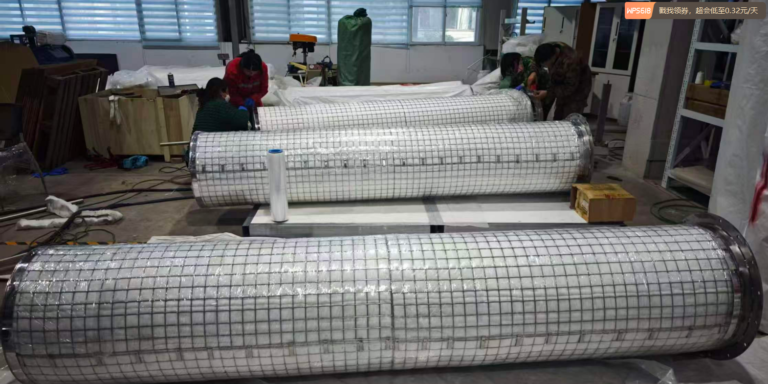
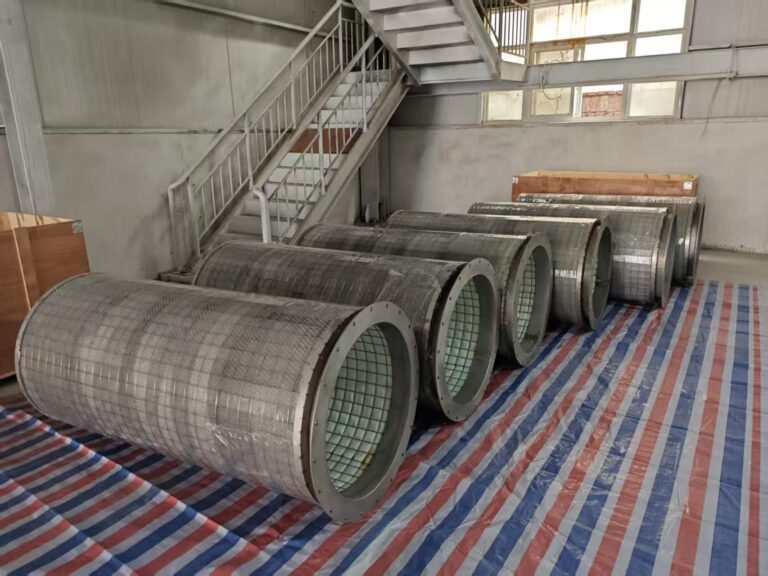
The combination of all three mechanisms gives Filtearth fiber bed mist eliminators a verified removal efficiency of 99.96% across the 0.1 to 3 micron range — capturing the submicron chlorine mist that wire mesh misses entirely.
Material Selection: Why PTFE Fiber Is Non-Negotiable in Chlor-Alkali Service
Material selection is the most critical engineering decision in chlor-alkali mist eliminator specification. The wrong material degrades rapidly, compromising both collection efficiency and structural integrity.
Fiber Medium
PTFE (Polytetrafluoroethylene) fiber is the only fiber material with reliable long-term resistance to the combined chlorine, HCl, and H₂SO₄ environment of a chlorine drying system. PTFE is chemically inert to all three components at the concentrations and temperatures encountered in industrial chlor-alkali service, and remains stable at operating temperatures up to 180°C.
Glass fiber — even acid-resistant specialty glass fiber — is not recommended for chlorine drying tower service due to gradual attack by wet chlorine and HCl over extended operating periods.
Polypropylene fiber offers moderate chlorine resistance but degrades at temperatures above 80°C and is not suitable for high-concentration chlorine service.
Filtearth specifies PTFE fiber as standard for all chlor-alkali mist eliminator applications.
Support Structure
| Component | Recommended Material | Reason |
|---|---|---|
| Inner and outer screens | Titanium or PTFE-coated FRP | Titanium: excellent Cl₂ and HCl resistance; PTFE-coated FRP: cost-effective alternative for lower temperatures |
| End plates and flanges | Titanium or PP | Titanium for high-temperature/high-concentration; PP for ambient temperature service |
| Vessel shell | FRP with PTFE liner, PP, or titanium | FRP with internal PTFE lining provides the best balance of corrosion resistance, mechanical strength, and cost |
Operating Specifications for Chlor-Alkali Service
| Parameter | Specification |
|---|---|
| Fiber material | PTFE fiber (standard) |
| Droplet capture range | 0.1–3 μm |
| Collection efficiency | 99.96% |
| Shell material | PP, FRP with PTFE liner, or titanium |
| Operating temperature | Up to 120°C (standard); up to 180°C (high-temperature series) |
| Chlorine concentration | Up to 100% Cl₂ by volume |
| Continuous operation | 24/7 duty rated |
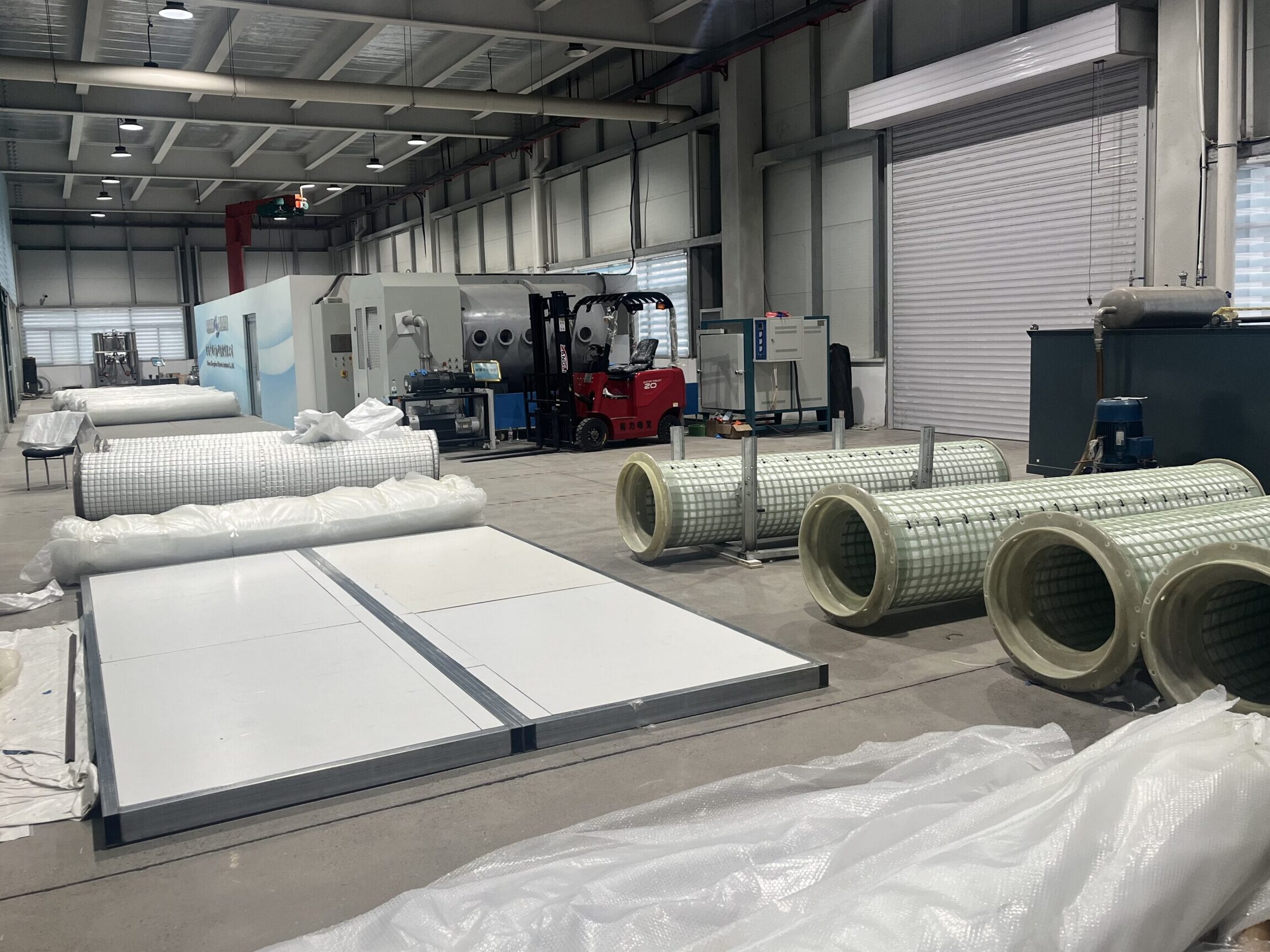
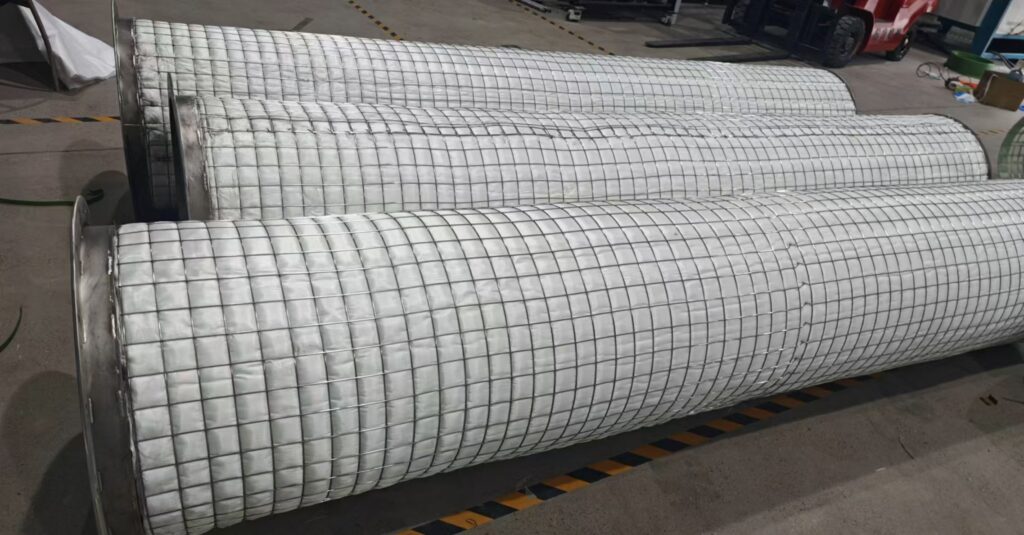
| Element diameter range | 200–1,500 mm |
| Outlet mist concentration | < 5 mg/Nm³ |
Installation Configurations for Southeast Asian Chlor-Alkali Plants
Single-Stage Fiber Bed — Chlorine Drying Tower Outlet
The most common configuration. A single fiber bed mist eliminator vessel installed at the outlet of the sulfuric acid drying tower captures residual acid mist and chlorine-bearing droplets before the dried chlorine gas enters the compressor suction.
This configuration is suitable for plants where inlet mist loading is moderate — typically below 200 mg/Nm³ — and the gas stream is predominantly chlorine with low particulate content.
Two-Stage System — Pre-Separator Plus Fiber Bed
For plants with higher liquid loading or variable inlet conditions, a wire mesh pre-separator upstream of the fiber bed removes bulk liquid carryover. The wire mesh handles droplets above 5 microns. The fiber bed polishes the remaining submicron mist to below 5 mg/Nm³.
In this configuration, the wire mesh pre-separator is specified in titanium or PVDF (polyvinylidene fluoride) for chlorine resistance, and the fiber bed element is PTFE fiber in a PP or FRP shell.
Retrofit into Existing Vessel
Many Southeast Asian chlor-alkali plants currently operate mesh pad demisters installed during original plant construction. When these reach end of service life or begin to underperform, Filtearth designs PTFE fiber bed replacement elements matched to the existing vessel internal dimensions.
Element diameter range: 200–1,500 mm. Existing vessel shells are retained. Only the internal element is replaced — no vessel modification, no civil work, no extended shutdown.
Reference Installations
Phosphate Fertilizer Plant — Malaysia
Fiber bed mist eliminator units supplied for acid mist control in a wet process phosphate fertilizer facility in Malaysia. PTFE fiber construction. Delivered within 30-day production cycle to meet project commissioning schedule. Continuous operation confirmed post-commissioning.
Relevance: Demonstrates Filtearth’s established supply capability in Malaysia and regional logistics competence.
Sulfuric Acid Plant — China
Multiple fiber bed units in absorption tower service with PTFE fiber construction. Long-term continuous operation with stable pressure drop and verified emission compliance.
Relevance: Same PTFE fiber specification and corrosion resistance requirement as chlor-alkali drying tower service.
Drying Tower Retrofit — Kazakhstan
Custom 25 mm fiber bed elements engineered to replace standard 50 mm units in a high-velocity drying tower. Pressure drop reduced from ~1,800 Pa to ~1,200 Pa. 99.96% efficiency maintained. 7 units, stable operation confirmed.
Relevance: Demonstrates retrofit engineering capability for non-standard operating conditions — directly applicable to Southeast Asian plants considering upgrade from wire mesh to fiber bed.
Operational and Economic Benefits
Compressor Protection
The primary economic justification for upgrading from wire mesh to fiber bed mist elimination in chlor-alkali service is compressor protection. Chlorine compressors are among the most capital-intensive and maintenance-intensive pieces of equipment in a chlor-alkali plant. Mist carryover above 5 mg/Nm³ causes accelerated corrosion of compressor internals, requiring unplanned maintenance, parts replacement, and extended downtime.
The cost of a single unplanned compressor maintenance event typically exceeds the total installed cost of a properly specified fiber bed mist eliminator system.
Reduced Drying Acid Consumption
Fine acid mist carryover from the drying tower represents direct product loss from the sulfuric acid drying circuit. Capturing this mist with a fiber bed mist eliminator — and returning the collected acid to the drying circuit — reduces drying acid makeup consumption.
Emission Compliance
Environmental regulators across Southeast Asia are tightening chlorine and acid mist emission limits. Malaysia’s Department of Environment and Indonesia’s KLHK both specify concentration limits for chlorine and acid gas emissions from industrial facilities. Fiber bed mist eliminators at 99.96% efficiency provide a reliable, auditable compliance solution.
Frequently Asked Questions
Why is PTFE fiber specified instead of specialty glass fiber for chlor-alkali service? Specialty glass fiber provides excellent resistance to sulfuric acid but is subject to gradual surface attack by wet chlorine gas and hydrochloric acid over extended operating periods. In pure sulfuric acid mist service, specialty glass fiber is a cost-effective and reliable choice. In chlor-alkali drying tower service, where chlorine and HCl are present alongside sulfuric acid, PTFE fiber is the correct specification for long-term performance. Filtearth specifies PTFE fiber as standard for all chlor-alkali applications.
Can Filtearth supply chlor-alkali mist eliminators to Malaysia and Indonesia? Yes. Filtearth supplies fiber bed mist eliminators to chemical plants across Southeast Asia. We have an established supply record in Malaysia and work with freight forwarders covering Port Klang, Tanjung Pelepas, and Tanjung Priok. Complete export documentation is provided as standard.
How does the cost of a Filtearth unit compare to European suppliers? Filtearth fiber bed mist eliminators are priced at approximately 70% of equivalent European and American brand specifications for the same performance level, material specification, and documentation standard. The 30-day production lead time is also significantly shorter than the 60 to 90 days typical of European suppliers.
What element sizes are available for chlor-alkali service? Filtearth manufactures PTFE fiber bed elements from 200 mm to 1,500 mm internal diameter. For retrofit applications, elements are custom-engineered to match existing vessel internal dimensions and nozzle layouts.
How long does a PTFE fiber bed element last in chlor-alkali service? In clean chlorine drying tower service with no solid particulate contamination, PTFE fiber elements typically achieve 3 to 5 years of service life. If the gas stream contains catalyst dust or solid carryover, a pre-filter upstream is recommended to protect element life.
What maintenance does a chlor-alkali fiber bed mist eliminator require? Routine maintenance consists of differential pressure monitoring and periodic visual inspection during planned shutdowns. A rising pressure drop indicates liquid loading or fouling. Element replacement is the primary maintenance activity, scheduled based on differential pressure trend rather than fixed time interval.
Request a Technical Quotation
If you are evaluating fiber bed mist eliminators for a chlor-alkali, sulfuric acid, or phosphoric acid application in Malaysia, Indonesia, Thailand, Vietnam, the Philippines, or anywhere in Southeast Asia, Filtearth is ready to provide a detailed technical proposal and commercial quotation within 24 hours.
To receive a quotation, please provide:
- Process gas type and composition (chlorine concentration, moisture content)
- Operating temperature and pressure
- Gas flow rate (m³/h or Nm³/h)
- Existing vessel dimensions (for retrofit applications)
- Inlet mist loading (if known)
- Required connection standard (ANSI / DIN / JIS)
Contact Henry Wang directly: Email: [email protected] WhatsApp: +86 159 365 10880
Response within 24 hours. Preliminary engineering assessment provided at no cost.