
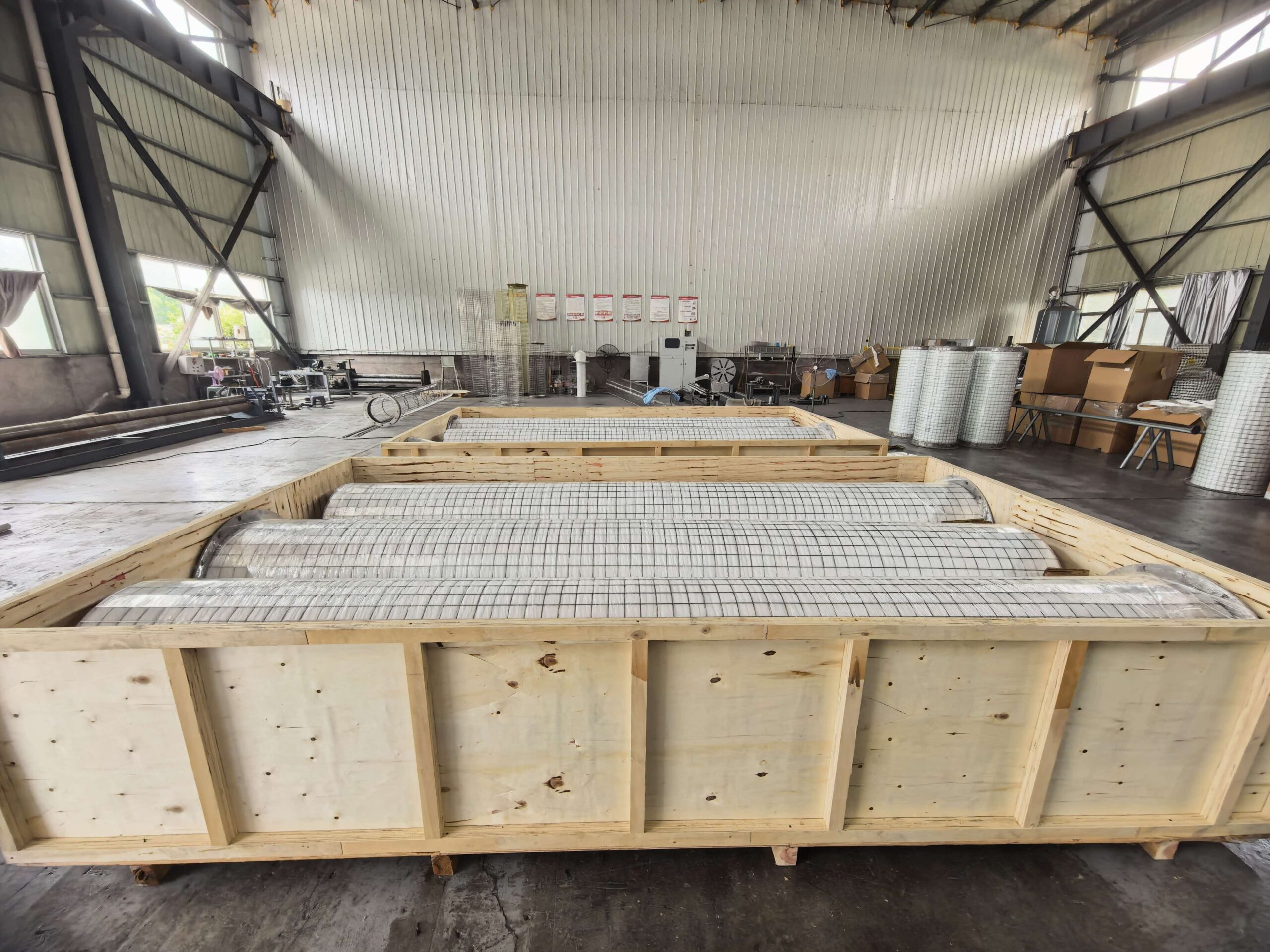
What is a Fiber Bed Mist Eliminator? Complete Guide
A fiber bed mist eliminator is an industrial gas-liquid separation device that removes submicron liquid droplets (0.1–3μm) from gas streams using a packed bed of fine PTFE or borosilicate glass fibers. It achieves greater than 99.96% mist removal efficiency through inertial impaction, direct interception, and Brownian diffusion.
How Does a Fiber Bed Mist Eliminator Work?
Gas enters the outer shell of the fiber bed mist eliminator and flows radially inward through the cylindrical fiber bed element. As gas passes through the fine fiber matrix, liquid droplets collide with and stick to the fibers. The captured droplets coalesce into larger drops that drain by gravity to the sump at the bottom of the vessel. Clean gas exits through the central core and is discharged from the top outlet.
Three capture mechanisms work simultaneously:
1. Inertial Impaction Larger droplets (>1μm) cannot follow the gas streamlines around fibers and collide directly with the fiber surface. This is the dominant mechanism for droplets above 1μm.
2. Direct Interception Medium droplets (0.3–1μm) follow the gas streamlines but come close enough to fiber surfaces to make contact. The droplet diameter determines whether contact occurs.
3. Brownian Diffusion Submicron particles (<0.3μm) move randomly due to molecular bombardment. This random motion causes them to contact fiber surfaces even when the streamlines do not pass directly over the fibers.
Fiber Bed Mist Eliminator vs Wire Mesh Demister
Many engineers ask why a fiber bed mist eliminator is needed when wire mesh demisters are simpler and cheaper. The answer lies in droplet size.
Wire mesh demisters capture droplets larger than 3–5μm by inertial impaction and are suitable for relatively coarse mist. However, the acid mist generated in sulfuric acid absorption towers, chlor-alkali electrolysis cells, and polysilicon reactors contains submicron droplets of 0.1–3μm — well below the capture range of wire mesh.
| Feature | Wire Mesh Demister | Fiber Bed Mist Eliminator |
|---|---|---|
| Droplet size captured | >3–5μm | 0.1–3μm |
| Removal efficiency | 85–95% | >99.96% |
| Submicron mist | Ineffective | Highly effective |
| Corrosion resistance | Limited | PTFE / Glass fiber |
| Maintenance | Frequent | Minimal |
| Service life | 1–2 years | 3–8 years |
What Materials Are Used in Fiber Bed Mist Eliminators?
The selection of fiber material and shell material depends on the chemical environment, temperature, and concentration of the mist stream.
Fiber Materials:
- PTFE fiber (3–25μm): Maximum chemical resistance. Used for concentrated sulfuric acid, hydrofluoric acid, mixed acids, and aggressive oxidizing environments. Operating temperature up to 200°C.
- Borosilicate glass fiber (1–10μm): Excellent chemical resistance to most acids and alkalis at moderate concentrations. Cost-effective choice for chlor-alkali, dilute sulfuric acid, and phosphoric acid service.
- Ceramic fiber: Used for high-temperature applications above 200°C.
Shell Materials:
- PP (Polypropylene): For dilute acid service below 80°C.
- FRP (Fiber-Reinforced Plastic): For moderate acid service, good corrosion resistance.
- 304/316L Stainless Steel: For high-temperature or high-pressure applications.
- Hastelloy C: For the most aggressive chemical environments.
Industries That Use Fiber Bed Mist Eliminators
Sulfuric Acid Plants Fiber bed mist eliminators are installed in drying towers and absorption towers to remove H₂SO₄ mist before gas is discharged to atmosphere. Emission standards typically require outlet concentration below 5 mg/Nm³ — achievable only with fiber bed technology.
Chlor-Alkali Industry Chlorine gas leaving electrolysis cells carries caustic mist and chlorine mist droplets. Fiber bed mist eliminators protect downstream compressors and heat exchangers from corrosion and fouling.
Polysilicon Manufacturing SiCl₄ and HCl mist from chemical vapor deposition reactors and hydrochlorination units must be removed to protect downstream equipment and meet environmental standards. High-purity PTFE fiber prevents silicon contamination.
Semiconductor Industry HF, HCl, and mixed acid mist from wet etching and cleaning processes require ultra-clean mist elimination. Fiber bed elements with zero particle shedding meet semiconductor cleanroom standards.
Phosphoric Acid and Fertilizer Plants Phosphoric acid mist from reaction tanks and evaporators is captured using glass fiber or PTFE fiber elements resistant to H₃PO₄.
Petrochemical Industry Oil mist, amine mist, and hydrocarbon droplets from gas treatment, amine scrubbing, and sulfur recovery units are removed using fiber bed elements matched to the specific hydrocarbon environment.
How to Size a Fiber Bed Mist Eliminator
Proper sizing of a fiber bed mist eliminator requires the following process data:
- Gas flow rate (Nm³/h or actual m³/h at operating conditions)
- Operating temperature (°C)
- Operating pressure (kPa absolute or gauge)
- Gas composition (including mist chemical identity and concentration)
- Mist droplet size distribution (if available)
- Required outlet emission concentration (mg/Nm³)
- Available installation space (vessel diameter and height constraints)
Based on this data, the engineer selects:
- Fiber diameter (finer fibers give higher efficiency but higher pressure drop)
- Packing density (3–15% solidity)
- Bed thickness (25–200mm)
- Face velocity (gas velocity through the fiber bed)
- Vessel diameter and element configuration
Typical pressure drop ranges from 50 to 2000 Pa depending on fiber grade and operating conditions.
How Long Does a Fiber Bed Mist Eliminator Last?
With proper installation and periodic inspection, fiber bed elements typically last 3–8 years. PTFE fiber elements in aggressive acid service generally last longer than glass fiber elements due to superior chemical resistance.
Factors that reduce service life include:
- Presence of solid particles in the gas stream (pre-filtration recommended)
- Thermal cycling beyond design limits
- Operating velocity significantly above design velocity
- Improper drainage causing liquid flooding of the element
Frequently Asked Questions
Q: Can a fiber bed mist eliminator handle gas streams with solid particles? Fiber bed mist eliminators are designed for liquid mist only. If solid particles are present, a cyclone separator or pre-filter should be installed upstream to protect the fiber bed element from blinding.
Q: What is the minimum droplet size a fiber bed mist eliminator can capture? Fiber bed mist eliminators using fine PTFE or glass fiber (1–3μm fiber diameter) can capture droplets as small as 0.1μm with high efficiency through Brownian diffusion.
Q: Can fiber bed mist eliminators be installed horizontally? Yes. Both vertical and horizontal configurations are available. Vertical installation is more common as it provides better liquid drainage by gravity. Horizontal units require special drainage design.
Q: How often does a fiber bed mist eliminator need maintenance? Under normal operating conditions, fiber bed elements require inspection every 12–24 months. Pressure drop monitoring provides early warning of element fouling or damage.
Filtearth has been manufacturing custom fiber bed mist eliminators since 2012, serving sulfuric acid plants, chlor-alkali facilities, polysilicon manufacturers, and semiconductor plants across Southeast Asia, the Middle East, and South Asia.
If you are evaluating a fiber bed mist eliminator for your application, send us your process data — gas flow rate, temperature, gas composition, and emission target — and our engineers will respond with a custom solution within 24 hours.
Contact us: [email protected] | WhatsApp: +86 159 365 10880
“Looking for a detailed comparison between fiber bed and wire mesh technology? Read our guide → Fiber Bed vs Wire Mesh Demister“
