Sulfuric Acid Mist Eliminator for Middle East Fertilizer and Petrochemical Plants
Filtearth Sulfuric Acid Mist Eliminator for Middle East Service
Sulfuric acid mist eliminator performance in Middle East fertilizer and petrochemical plants is a critical compliance requirement — Saudi Arabia, UAE, and Egypt all mandate outlet concentrations below 5 mg/Nm³ for new installations. Saudi Arabia, UAE, Egypt, and Kuwait operate some of the world’s largest sulfuric acid production facilities — supplying phosphate fertilizer complexes, petrochemical plants, and metal processing industries across the region. As environmental standards align with European IED levels for new installations and plant operators face increasing pressure to protect downstream equipment, the gap between what wire mesh demisters deliver and what modern compliance requirements demand has never been wider.
Filtearth designs and manufactures custom fiber bed mist eliminators for Middle East sulfuric acid service — achieving 99.96% removal efficiency at approximately 70% of the cost of European and American imported units, with a 30-day production lead time and full documentation for Gulf procurement compliance.
Sulfuric Acid Production in the Middle East: Scale and Context
The Middle East sulfuric acid industry is tied directly to the region’s fertilizer and petrochemical sectors:
Saudi Arabia: Ma’aden Phosphate Company operates one of the world’s largest integrated phosphate complexes at Wa’ad Al Shamal, consuming massive quantities of sulfuric acid for phosphoric acid production. SABIC and Saudi Aramco affiliates operate additional sulfuric acid units in Jubail and Yanbu industrial cities.
UAE: Fertil and ADNOC affiliates in Ruwais and Abu Dhabi operate sulfuric acid units serving downstream fertilizer and chemical production. Jebel Ali industrial zone hosts several chemical facilities with sulfuric acid consumption.
Egypt: Egyptian Fertilizers Company (EFC), Abu Qir Fertilizers, and several other producers operate contact process sulfuric acid plants in the Alexandria industrial zone and along the Suez Canal corridor.
Kuwait: PIC (Petrochemical Industries Company) operates sulfuric acid production in Shuaiba industrial area serving the regional petrochemical sector.
All of these facilities generate acid mist at drying tower and absorption tower outlets that must be controlled to meet both equipment protection requirements and environmental emission standards.
The Acid Mist Problem in Middle East Sulfuric Acid Plants
Where Mist Is Generated
In a double absorption sulfuric acid plant — the standard configuration for modern Middle East facilities — acid mist is generated at two critical points:
Drying tower: Ambient air fed to the sulfur burner contains moisture. Contact with 93 to 98% sulfuric acid in the drying tower produces fine H₂SO₄ droplets, predominantly in the submicron range, that become entrained in the dried air stream.
Absorption towers (intermediate and final): SO₃ gas from the converter contacts 98 to 99% sulfuric acid in the absorption towers. The reaction generates extremely fine sulfuric acid mist — predominantly 0.1 to 1 micron in diameter — at mist concentrations of 100 to 500 mg/Nm³ leaving the absorption packing.
This submicron mist is invisible, highly corrosive, and completely outside the effective capture range of wire mesh demisters.
The Middle East Operating Environment
Middle East sulfuric acid plants face additional challenges that compound the acid mist problem:
High ambient temperature: Gulf ambient temperatures of 40 to 50°C in summer reduce the efficiency of gas cooling between process stages. Warmer gas holds more moisture, increasing the potential for acid mist generation in the drying circuit.
Continuous 24/7 operation: Middle East fertilizer and petrochemical facilities operate without the seasonal shutdowns common in some other regions. Mist elimination equipment must perform reliably under continuous duty for 3 to 5 year intervals between major shutdowns.
High SO₂ throughput: Large-scale Middle East sulfuric acid plants — some producing 3,000 to 5,000 tonnes per day — generate correspondingly high gas flow rates through absorption towers. At high gas velocities, wire mesh demisters in absorption tower service are completely ineffective for submicron acid mist capture.
Regulatory Standards Applicable to Middle East Sulfuric Acid Plants
Saudi Arabia — MEWA Standards
Saudi Arabia’s Ministry of Environment, Water and Agriculture (MEWA) applies emission guidelines for industrial facilities that align with European standards for new installations:
| Parameter | New Installation Limit |
|---|---|
| Sulfuric acid mist (H₂SO₄) | ≤ 5 mg/Nm³ |
| Sulfur dioxide (SO₂) | ≤ 700 mg/Nm³ |
Major industrial developments under Vision 2030 — including NEOM, Ras Al-Khair, and Wa’ad Al Shamal expansions — are required to meet the 5 mg/Nm³ acid mist limit as a condition of environmental approval.
UAE — Federal Environmental Standards
UAE environmental standards for new chemical and industrial facilities in Abu Dhabi and Dubai industrial zones align with EU IED BAT-AEL levels:
| Parameter | Emission Guideline |
|---|---|
| Acid mist (H₂SO₄) | ≤ 5 mg/Nm³ |
Abu Dhabi’s Environment Agency and Dubai’s Environment and Climate Change Authority both require new sulfuric acid plant installations to demonstrate compliance with this limit before permit issuance.
Egypt — EEAA Standards
Egypt’s Environmental Affairs Agency applies emission standards under Law 4 of 1994 and amendments:
| Facility Type | Acid Mist Limit |
|---|---|
| Existing plants | ≤ 30 mg/Nm³ |
| New installations | ≤ 5–10 mg/Nm³ |
Why Wire Mesh Demisters Fail in Middle East Sulfuric Acid Service
Standard knitted wire mesh demisters installed in Middle East absorption tower service capture droplets above 5 to 10 microns by inertial impaction. At the high gas velocities present in large-capacity absorption towers, even this coarse capture function is compromised — liquid is re-entrained from wire mesh surfaces at high velocity rather than draining.
The acid mist generated in sulfuric acid absorption towers — predominantly 0.1 to 1 micron — follows gas streamlines through wire mesh openings without fiber contact. Collection efficiency for submicron acid mist in wire mesh service is typically below 50%, resulting in outlet concentrations of 50 to 200 mg/Nm³.
At 50 to 200 mg/Nm³:
- Tail gas stacks visible as acid mist plumes — a regulatory compliance flag
- Downstream heat exchangers and fans corrode at accelerated rates
- Acid recovery is reduced — product loss through the stack
- New installation permits in Saudi Arabia, UAE, and Egypt cannot be obtained
Filtearth Engineering Solution for Middle East Sulfuric Acid Service
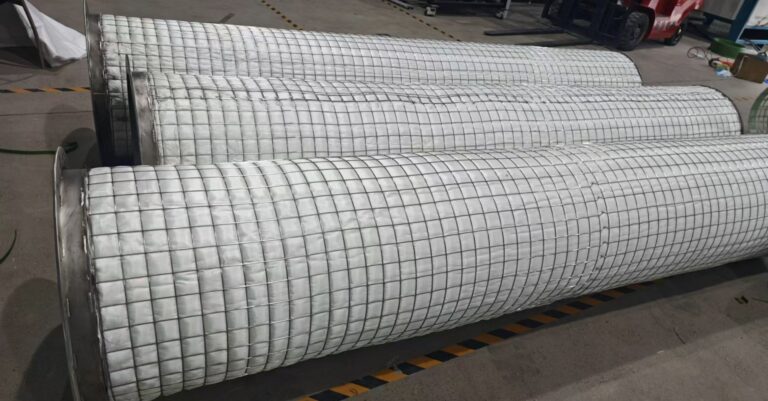
Proprietary Glass Fiber Construction
Filtearth uses proprietary glass fiber as the standard fiber specification for sulfuric acid drying tower and absorption tower service across Middle East applications:
- Complete resistance to concentrated H₂SO₄ at all absorption tower concentrations (93 to 99%)
- Fine fiber diameter (3 to 8 microns) for maximum submicron collection efficiency
- Stable performance at Middle East operating temperatures up to 120°C
- Service life of 3 to 5 years under continuous duty conditions
Collection efficiency: 99.96% Outlet acid mist concentration: < 5 mg/Nm³ Meets: MEWA, UAE, and EEAA new installation limits
Configuration for Double Absorption Plants
For double absorption sulfuric acid plants — the standard configuration in large Middle East facilities — Filtearth typically supplies fiber bed mist eliminators at three positions:
Position 1 — Drying tower outlet: Captures H₂SO₄ mist from the drying circuit before the gas enters the sulfur burner. Prevents acid carryover into the converter feed gas.
Position 2 — Intermediate absorption tower outlet: Captures acid mist from the first absorption stage before the gas re-enters the converter for second-pass SO₃ generation.
Position 3 — Final absorption tower outlet (tail gas): The most critical position for emission compliance. Captures the final acid mist fraction before stack discharge. This is the position where outlet concentration is measured for regulatory compliance.
Shell and Support Materials for Gulf Service
| Component | Specification | Reason |
|---|---|---|
| Vessel shell | FRP or SS316L | Concentrated H₂SO₄ resistance |
| Inner and outer screens | Alloy 20 or SS316L | H₂SO₄ service |
| Flange connection | ANSI 150# or 300# | Standard for Gulf region projects |
| Design standard | ASME Section VIII | Required for Gulf industrial projects |
Operating Specifications
| Parameter | Specification |
|---|---|
| Fiber material | Filtearth proprietary glass fiber |
| Collection efficiency | 99.96% |
| Outlet concentration | < 5 mg/Nm³ |
| Droplet capture range | 0.1–3 μm |
| Operating temperature | Up to 120°C |
| Element diameter range | 200–1,500 mm |
| Design standard | ASME Section VIII Div. 1 |
Cost and Lead Time Advantage Over European Suppliers
Middle East EPC contractors and plant operators sourcing sulfuric acid mist eliminators from European suppliers — the traditional procurement source for Gulf chemical projects — face significant cost and schedule disadvantages:
| European / American Suppliers | Filtearth | |
|---|---|---|
| Unit cost (equivalent specification) | Baseline 100% | ~70% of European cost |
| Production lead time | 60–90 days | 30 days |
| Documentation standard | Full material certs | Full material certs — standard |
| ASME vessel design | Available | Available |
| ANSI connection standard | Standard | Standard |
| Gulf port shipping | Long transit from Europe/USA | Shorter transit from China |
For a large double absorption plant requiring fiber bed units at three positions, the total procurement cost saving versus European suppliers — at 30% per unit — represents a significant capital cost reduction on what is typically a multi-hundred-thousand-dollar equipment line item.
Reference Installations
Sulfuric Acid Plant — Taiyuan, China (400,000 t/a)
Complete retrofit of absorption tower mist collectors at a large Chinese sulfuric acid plant. Same corrosive environment and operating conditions as Middle East double absorption plants. Stable operation confirmed post-commissioning with outlet concentrations below 5 mg/Nm³.
Drying Tower Retrofit — Kazakhstan
Custom-engineered 25 mm fiber bed elements replacing standard 50 mm units at elevated gas velocity. Pressure drop reduced from ~1,800 Pa to ~1,200 Pa while maintaining 99.96% efficiency. Demonstrates Filtearth’s capability for non-standard engineering in corrosive acid service — directly applicable to Middle East plants requiring custom solutions for existing vessel constraints.
Phosphate Fertilizer Plant — Malaysia
Fiber bed mist eliminators in phosphoric acid concentrator service — same client profile as Middle East fertilizer complex procurement teams. 30-day delivery to regional port confirmed.
EPC Contractor and Plant Procurement Support
Middle East EPC contractors and plant operators have specific procurement documentation requirements that Filtearth satisfies as standard:
Technical documentation:
- Engineering calculations (sizing, pressure drop, face velocity)
- Material data sheets for all wetted components
- ASME U-stamp or PED certification (available on request for specific projects)
- Dimensional drawings with all nozzle details and flange ratings
Quality documentation:
- Material certificates for fiber, screens, shell, and all pressure-retaining components
- Dimensional inspection records
- Hydrostatic pressure test reports
- Weld inspection records (for welded pressure vessels)
Commercial documentation:
- Commercial invoice with HS code
- Packing list
- Certificate of origin
- SGS inspection certificate (available on request)
All documentation provided in English as standard. Arabic translation of key documents available on request for Saudi and Egyptian procurement requirements.
Frequently Asked Questions
Does Filtearth supply sulfuric acid mist eliminators that meet MEWA’s 5 mg/Nm³ limit for Saudi Arabia? Yes. Filtearth proprietary glass fiber bed mist eliminators consistently achieve outlet acid mist concentrations below 5 mg/Nm³ under design operating conditions — meeting MEWA’s new installation limit for Saudi Arabia and equivalent limits in UAE and Egypt.
Can Filtearth provide ASME-stamped pressure vessels for Gulf projects? Yes. Filtearth designs fiber bed mist eliminator vessels to ASME Section VIII Division 1. For projects requiring a formal ASME U-stamp, this can be arranged through our quality management process. Specify ASME U-stamp requirement at the time of enquiry.
What is the delivery timeline to Gulf ports from order confirmation? Standard production lead time is 30 days from order confirmation, excluding shipping. Sea freight transit from Chinese ports to Jebel Ali (UAE) is approximately 12 to 15 days, and to Dammam (Saudi Arabia) approximately 15 to 18 days. Total delivery time from order to port arrival is typically 45 to 50 days — significantly shorter than the 90 to 120 days typical for European suppliers shipping to the same destinations.
Can Filtearth replace existing imported fiber bed elements in Middle East sulfuric acid plants? Yes. Filtearth designs performance-matched replacement elements for existing vessels from European and American suppliers. Provide vessel internal dimensions and process conditions, and Filtearth will confirm dimensional compatibility and supply a matched replacement element at approximately 70% of the original import cost.
Does Filtearth have experience with Middle East EPC procurement requirements? Yes. Filtearth has supplied industrial process equipment to EPC-managed projects in Central Asia and Southeast Asia with full technical and quality documentation packages. We understand the material requisition, technical deviation, and vendor qualification processes typical of Gulf EPC project procurement and can provide the required documentation at each stage.
Request a Technical Quotation
If you are evaluating sulfuric acid mist eliminators for a new installation, retrofit, or element replacement in Saudi Arabia, UAE, Egypt, Kuwait, or anywhere in the Middle East, Filtearth is ready to provide a detailed technical proposal and commercial quotation within 24 hours.
To receive a quotation, please provide:
- Plant location and annual sulfuric acid production capacity
- Application position (drying tower, intermediate absorption, final absorption)
- Gas flow rate (Nm³/h) per position
- Operating temperature and acid concentration
- Required connection standard (ANSI 150# / 300# preferred for Gulf projects)
- Existing vessel dimensions (for retrofit applications)
- Required delivery port (Jebel Ali, Dammam, Sohar, or Alexandria)
Contact Henry Wang directly: Email: [email protected] WhatsApp: +86 159 365 10880
Response within 24 hours. ASME design and full EPC documentation package available on request.