Fiber Bed Mist Eliminator vs Wire Mesh Demister: Which One Should You Choose?
Fiber Bed Mist Eliminator vs Wire Mesh Demister:
When specifying mist elimination equipment, engineers and procurement teams face a recurring choice: fiber bed mist eliminator or wire mesh demister? Both remove liquid droplets from gas streams, but they do so through different mechanisms, at different efficiency levels, and with different cost profiles.
Choosing the wrong technology means either overspending on performance you do not need, or installing equipment that fails to meet your emission targets. This article breaks down the differences clearly so you can make the right call for your process.
How Each Technology Works
How a Wire Mesh Demister Works
A wire mesh demister consists of a knitted pad of metal or plastic wire, typically 100 to 150 mm thick, installed across the gas flow path. As gas passes through the pad, droplets collide with wire surfaces, coalesce into larger drops, and drain downward by gravity.
The mechanism is primarily inertial impaction. This works well when droplets are large enough to have meaningful inertia — generally above 5 to 10 microns. Below that size, small droplets follow the gas streamlines and pass straight through the mesh without making contact.
Wire mesh demisters are simple, low-cost, and easy to install. They perform reliably in bulk liquid separation duties where droplet sizes are relatively large.
How a Fiber Bed Mist Eliminator Works
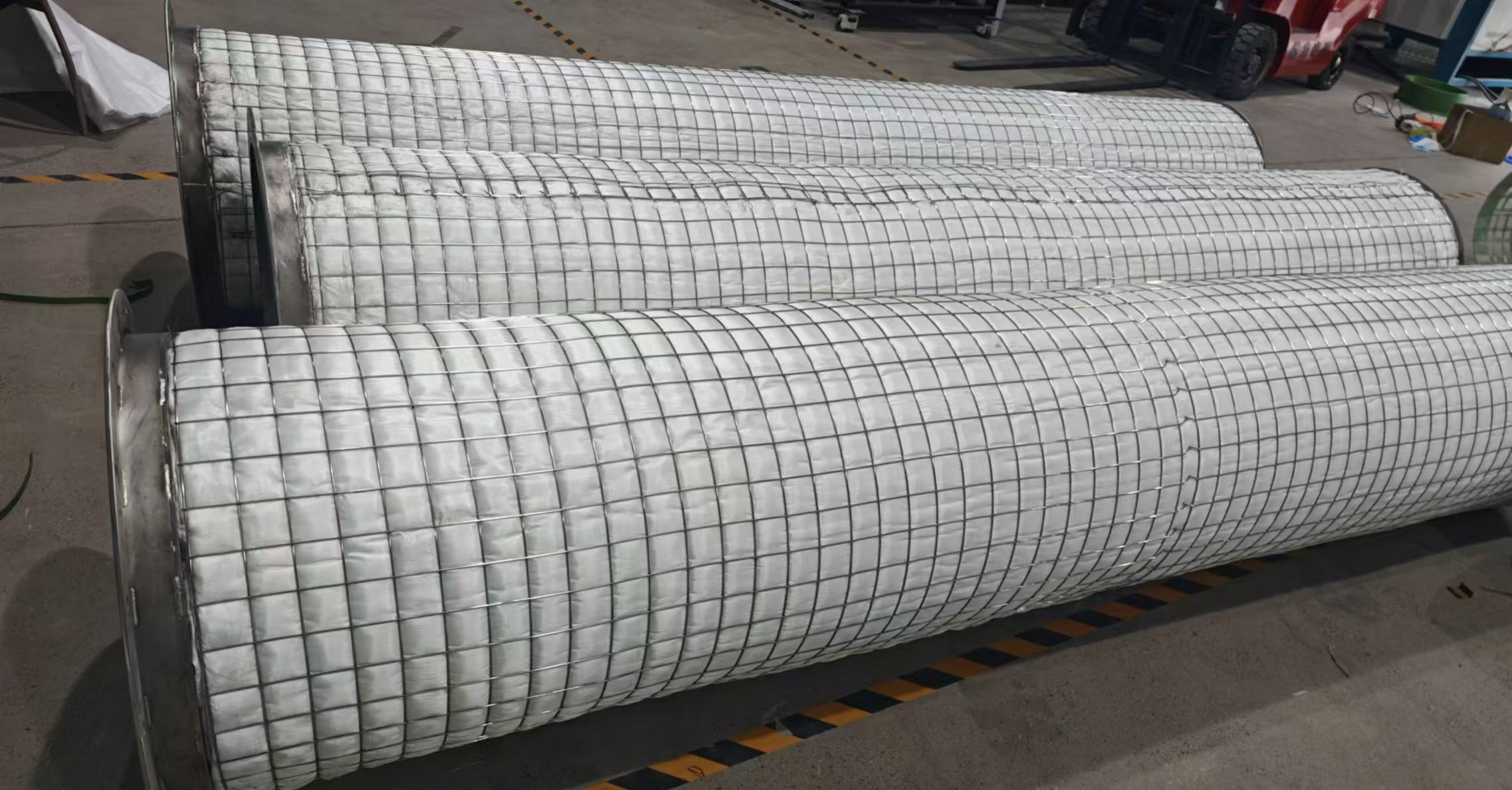
A fiber bed mist eliminator passes gas through a packed bed of fine-diameter fibers, typically fiberglass, PTFE, or polypropylene. The fiber diameter is orders of magnitude smaller than wire mesh wire, which dramatically increases the surface area available for droplet capture.
Three mechanisms operate simultaneously: inertial impaction for larger droplets, interception for mid-sized droplets, and Brownian diffusion for submicron particles. This combination allows fiber bed units to capture droplets well below 1 micron in diameter — a size range completely outside the capability of wire mesh.
Captured droplets coalesce on fiber surfaces, drain to the bottom of the vessel, and are removed continuously. The result is a clean gas stream with 99.96% of mist removed.
Head-to-Head Comparison
Filtration Efficiency
This is the most important difference between the two technologies.
Wire mesh demisters typically achieve 95% to 99% removal efficiency for droplets above 5 microns. For coarse mist in distillation columns or scrubbers handling large droplets, this is often sufficient.
Fiber bed mist eliminators achieve 99.96% removal efficiency, including submicron aerosols. In applications like sulfuric acid mist control, oil aerosol recovery, or pharmaceutical solvent capture, this level of performance is not optional — it is required.
If your process generates fine or ultra-fine mist, wire mesh will not meet your emission targets regardless of how well it is installed or maintained.
Minimum Droplet Size
| Technology | Effective Minimum Droplet Size |
|---|---|
| Wire mesh demister | 5–10 microns |
| Fiber bed mist eliminator | < 1 micron (submicron) |
This single specification often determines which technology is appropriate. If your process documentation or stack test data shows droplets below 5 microns, wire mesh is the wrong choice.
New to fiber bed technology? Read our complete guide: What Is a Fiber Bed Mist Eliminator?
Pressure Drop
Wire mesh demisters operate at very low pressure drop — typically 50 to 200 Pa under normal conditions. This is one of their genuine strengths. For large-volume gas streams where energy cost is a primary concern, this matters.
Fiber bed mist eliminators have a higher but still manageable pressure drop — typically 200 to 800 Pa depending on fiber density, bed thickness, and face velocity. This is stable over the service life of the element and predictable during design.
The pressure drop difference rarely changes the technology selection decision on its own, but it is a real factor in system energy budgeting.
Liquid Loading Capacity
Wire mesh handles moderate to high liquid loading well. The open structure allows liquid to drain freely without flooding the pad under normal conditions. In applications with heavy bulk liquid entrainment — for example, above a distillation tray — mesh pads are a practical and cost-effective first-stage separator.
Fiber beds are designed for fine mist duty, not bulk liquid separation. High liquid loading can flood the fiber bed, increase pressure drop sharply, and reduce efficiency. In processes with both bulk liquid carryover and fine mist, a wire mesh pre-separator upstream of the fiber bed is the standard design approach.
Maintenance and Service Life
Wire mesh demisters are simple to inspect and replace. A standard knitted mesh pad costs relatively little and can be swapped out during a planned shutdown. The main failure modes are fouling with solids, corrosion, and physical distortion from high gas velocity.
Fiber bed elements have a longer service life — typically 2 to 5 years in clean mist service — but replacement cost is higher. The fiber element must be matched to the chemical environment; incorrect material selection accelerates degradation. Differential pressure monitoring is essential to track condition.
Capital Cost
Wire mesh demisters cost significantly less upfront. A standard mesh pad for an industrial vessel may cost a fraction of the equivalent fiber bed element. Installation is straightforward and requires no special equipment.
Fiber bed mist eliminators require a purpose-built vessel, a properly designed support structure, and a matched fiber element. Total installed cost is considerably higher. However, when regulatory fines, product loss through the stack, or downstream equipment damage are factored in, the economics frequently favor fiber bed technology for high-efficiency applications.
Which One Should You Choose?
Use this decision framework based on your process requirements:
Choose wire mesh demister when:
- Droplets are predominantly above 5–10 microns
- You need a simple, low-cost bulk liquid separator
- The application is a distillation column, scrubber inlet, or similar large-droplet duty
- Efficiency of 95–99% meets your regulatory or process requirements
- Budget and simplicity are the primary constraints
Choose fiber bed mist eliminator when:
- Droplets include submicron or ultra-fine aerosols
- Your process generates acid mist, oil aerosol, or solvent vapor
- Regulatory emission limits require efficiency above 99%
- Product recovery from the gas stream has economic value
- Downstream equipment must be protected from fine liquid carryover
Use both in combination when:
- The gas stream contains heavy bulk liquid entrainment AND fine mist
- Install wire mesh upstream as a pre-separator, fiber bed downstream for final polishing
Real-World Application Examples
Sulfuric acid plant tail gas: Fine sulfuric acid mist with droplets predominantly below 3 microns. Wire mesh provides inadequate capture. Fiber bed mist eliminator at 99.96% efficiency is the industry standard for this duty.
Distillation column overhead: Water and hydrocarbon droplets ranging from 10 to 200 microns. Wire mesh demister installed on the column outlet handles this effectively at low cost.
CNC machining shop central ventilation: Metalworking oil mist with a wide droplet size distribution including submicron components. A two-stage system — mesh pre-filter plus fiber bed — is the recommended configuration for clean room and environmental compliance.
Pharmaceutical solvent recovery: Fine solvent aerosols from reactor vents. Fiber bed technology with PTFE or polypropylene fiber to resist chemical attack, achieving 99.96% recovery efficiency.
Frequently Asked Questions
Can I upgrade a wire mesh demister to fiber bed technology? In many cases, yes. If the existing vessel is large enough to accommodate the fiber bed element and support structure, the internals can be replaced. Filtearth offers assessment services to evaluate whether an existing vessel is suitable for conversion.
Is fiber bed technology always better than wire mesh? Not always. For large-droplet bulk separation duties, wire mesh is simpler, cheaper, and fully adequate. Fiber bed technology adds cost and complexity that is only justified when fine mist capture is genuinely required.
What fiber materials does Filtearth offer? Filtearth manufactures fiber bed mist eliminators with fiberglass, borosilicate glass, PTFE-coated glass, polypropylene, and stainless steel fiber. Material selection depends on the chemical compatibility, temperature, and efficiency requirements of your process.
How do I know what droplet size my process generates? Stack testing with an impactor or cascade sampler provides the most reliable data. Process simulation and vendor data for your upstream equipment can also give a reasonable estimate. Contact Filtearth for guidance on specifying the right technology for your application.
Summary
Wire mesh demisters and fiber bed mist eliminators are not interchangeable. They serve different parts of the droplet size spectrum, at different efficiency levels, and with different cost profiles.
For bulk liquid separation with large droplets, wire mesh is a practical and cost-effective solution. For fine mist, submicron aerosols, and applications where 99.96% efficiency is required, fiber bed mist eliminator technology is the only reliable answer.
Filtearth — Henan Filtearth Environmental Protection Technology Co., Ltd. — specializes in fiber bed mist eliminator design and manufacture for the chemical, metalworking, pharmaceutical, and power generation industries.
Have a specific application in mind? Contact Henry Wang at [email protected] or WhatsApp +86 159 365 10880 to discuss your process requirements and get a recommendation.
Explore Filtearth’s full fiber bed mist eliminator product range → Mist Eliminator