Amine Mist Eliminator for Natural Gas Sweetening Plants: Reducing Amine Loss and Protecting Downstream Equipment
Amine mist eliminator performance in natural gas sweetening plants directly determines operating cost, gas quality compliance, and downstream equipment life. Every kilogram of amine solution that leaves the absorber column as entrained mist represents a direct chemical makeup cost, a potential gas quality specification violation, and a source of progressive corrosion damage to compressors, pipelines, and heat exchangers downstream.
For natural gas processing plants in the Middle East, Latin America, and Southeast Asia — where amine gas treating units run continuously at high throughput — the difference between a wire mesh demister and a properly specified amine mist eliminator translates into hundreds of thousands of dollars per year in avoidable amine loss and maintenance cost.
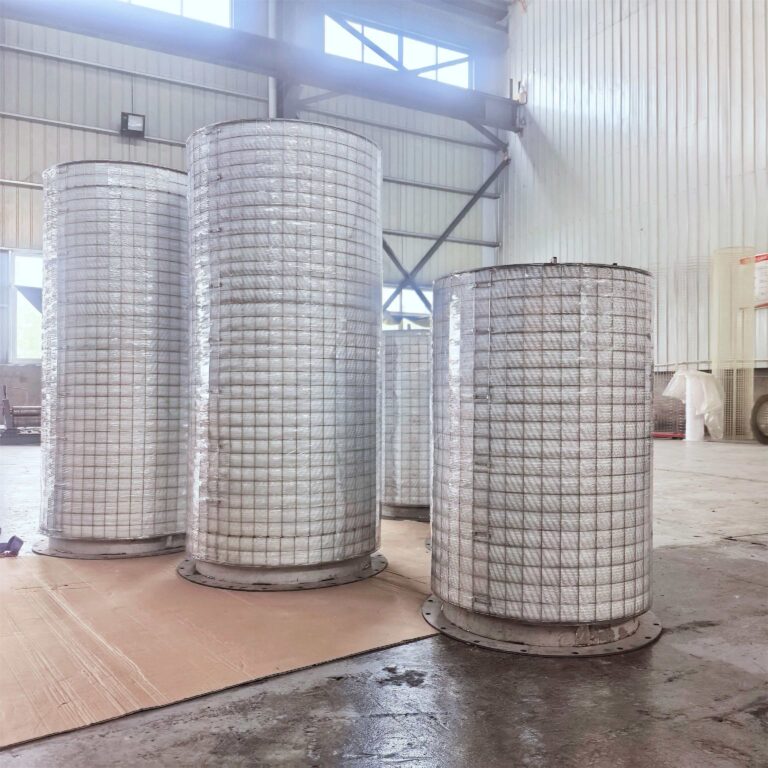
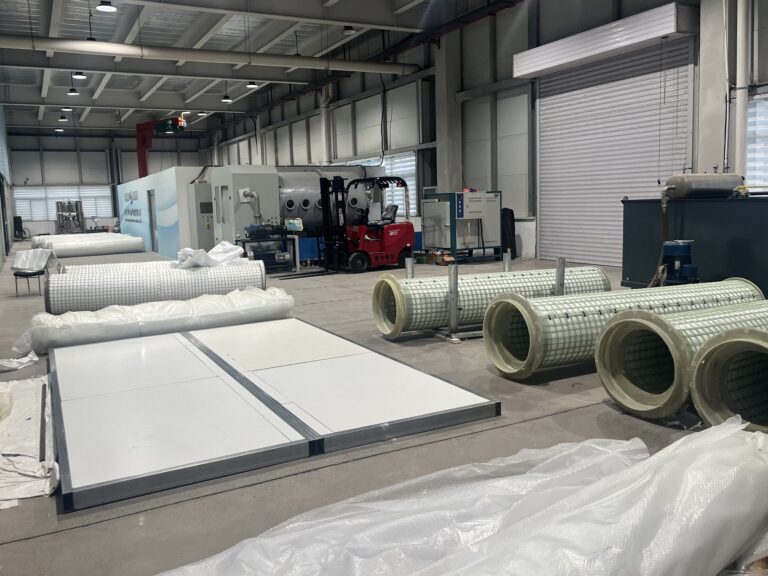
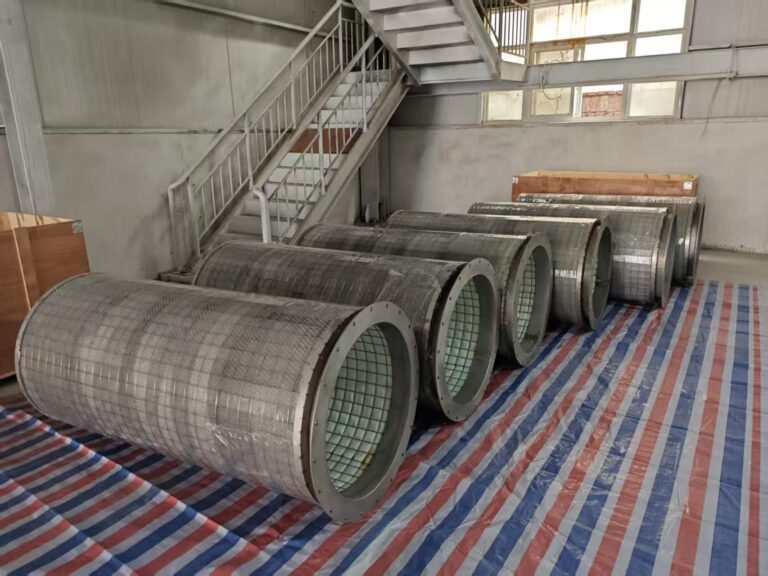
Filtearth designs and manufactures amine mist eliminators for natural gas sweetening service using Filtearth proprietary glass fiber — achieving 99.96% removal efficiency and outlet amine concentrations below 5 mg/Nm³, at approximately 70% of the cost of European and American imported units with a 30-day production lead time.
How Amine Gas Treating Works — and Where Mist Originates
The Absorption Process
Natural gas sweetening using amine solution follows a standard absorption-regeneration cycle. Sour gas — containing hydrogen sulfide (H₂S) and carbon dioxide (CO₂) — enters the bottom of the absorber column and flows upward through structured packing or trays. Lean amine solution enters the top of the absorber and flows downward, selectively absorbing H₂S and CO₂ as it contacts the sour gas.
Sweet gas — with H₂S and CO₂ removed to pipeline specification — exits from the top of the absorber column. Rich amine — loaded with absorbed acid gases — exits from the bottom and is regenerated in the stripper column before being recirculated to the absorber.
Where Amine Mist Forms
The sweet gas leaving the absorber top carries entrained amine solution in two distinct forms:
Bulk liquid droplets (above 5 microns): Generated by gas-liquid contact in the top packing bed and by liquid redistribution at the absorber top. These larger droplets are partially captured by wire mesh demisters through inertial impaction.
Fine aerosol mist (0.1 to 3 microns): Formed by evaporation and re-condensation of amine vapors in the cooler gas at the absorber top, and by gas-liquid surface turbulence in the packing. This fine aerosol fraction is the dominant source of amine loss in plants with wire mesh demisters — it passes through wire mesh without capture and accounts for 60 to 80% of total amine carryover measured at the absorber outlet.
An amine mist eliminator using Filtearth proprietary glass fiber captures both fractions — bulk droplets through inertial impaction and fine aerosols through direct interception and Brownian diffusion — achieving total amine carryover below 5 mg/Nm³.
Amine Loss Quantification: The Economic Case
Calculating Annual Amine Loss Cost
For a natural gas sweetening plant, amine loss through the absorber overhead is directly quantifiable:
Example: MDEA plant, 100 MMscfd throughput
- Typical wire mesh outlet amine concentration: 80 mg/Nm³
- Typical fiber bed outlet amine concentration: 4 mg/Nm³
- Gas volume: 100 MMscfd = ~2.83 million Nm³/day = ~1,032 million Nm³/year
- Annual amine loss reduction: (80 − 4) mg/Nm³ × 1,032 million Nm³ = ~78,400 kg/year
- MDEA cost: approximately USD 2.00/kg
- Annual amine cost saving: ~USD 157,000/year
For a Filtearth amine mist eliminator installed cost of USD 40,000 to 100,000 for a unit of this size, payback period based on amine chemical saving alone is 3 to 8 months.
Additional Economic Benefits
Beyond direct amine chemical savings, an amine mist eliminator delivers four additional economic benefits:
Compressor maintenance reduction: Amine deposits on centrifugal compressor impellers cause imbalance and vibration. Compressor seal replacement intervals extend from 12 to 24 months (with wire mesh) to 36 to 60 months (with fiber bed), saving USD 30,000 to 150,000 per maintenance event.
Pipeline corrosion reduction: Amine carryover into sales gas pipelines deposits on pipe walls, promoting corrosion under deposits. Fiber bed mist elimination reduces pipeline inspection frequency and corrosion inhibitor injection rates.
Gas quality compliance: Pipeline operators impose strict limits on amine content in delivered gas. Violations result in gas rejection and commercial penalties. Fiber bed technology eliminates amine carryover as a gas quality compliance risk.
Reduced amine degradation: Amine that leaves the absorber as mist and is recovered in downstream knockout drums is often thermally or oxidatively degraded, reducing its treating capacity. Lower amine loss means less degraded amine is returned to the system, improving treating efficiency.
Amine Mist Eliminator Design for Natural Gas Service
Filtearth Proprietary Glass Fiber for Amine Service
Filtearth proprietary glass fiber is the standard fiber specification for amine gas treating mist eliminators:
Chemical compatibility: Stable in contact with all common amine treating solutions — MEA (monoethanolamine), DEA (diethanolamine), MDEA (methyldiethanolamine), piperazine-activated MDEA, and DGA (diglycolamine) — at absorber operating concentrations and temperatures.
Fine fiber diameter (3 to 8 μm): Maximizes collection efficiency for submicron amine aerosols through direct interception and Brownian diffusion — the dominant mechanisms for the fine mist fraction responsible for the majority of amine loss.
Resistance to amine degradation products: Amine solutions in long-term service accumulate heat-stable salts and oxidative degradation products. Filtearth proprietary glass fiber maintains chemical resistance to aged amine solutions containing common degradation compounds.
Collection efficiency: 99.96% Outlet amine concentration: < 5 mg/Nm³ Service life: 3 to 5 years in clean amine service
Shell and Support Materials
| Component | Material | Reason |
|---|---|---|
| Vessel shell | Carbon steel or SS316L | H₂S service — NACE MR0175 compliance where specified |
| Inner and outer screens | SS316L | Amine and H₂S corrosion resistance |
| End plates | SS316L | Matched to screen material |
| Vessel design | ASME Section VIII Div. 1 | High-pressure gas processing service |
| Connection standard | ANSI 150# or 300# | Standard for gas processing plant connections |
| H₂S service | NACE MR0175 / ISO 15156 | Required for sour gas service above H₂S threshold |
Design Pressure Capability
Natural gas sweetening absorbers operate at pressures ranging from 20 bar (low-pressure distribution gas treating) to 100 bar (high-pressure offshore and pipeline gas treating). Filtearth designs amine mist eliminator vessels to ASME Section VIII Division 1 for the full pressure range required by gas processing applications.
For high-pressure service (above 50 bar), vessel wall thickness, nozzle reinforcement, and post-weld heat treatment are specified per ASME requirements. NACE MR0175 / ISO 15156 material selection compliance is available for sour service applications where H₂S partial pressure exceeds the NACE threshold.
Installation Configurations
External Vessel on Absorber Overhead Line
The most common configuration for amine mist eliminator retrofits in existing gas treating plants. A dedicated fiber bed vessel is installed on the absorber overhead piping between the absorber top nozzle and the downstream gas cooler or scrubber.
Advantages:
- No modification to the existing absorber column
- Installable during an 8 to 24 hour planned shutdown
- Accessible for element inspection and replacement without taking the absorber offline
- Sized independently of the absorber column — optimal face velocity regardless of column diameter
Element diameter range: 200 to 1,500 mm for flow rates from small field gas treating units to large refinery and LNG feed gas treating trains.
In-Column Fiber Bed Element
For new gas treating plants designed from the outset with fiber bed mist elimination, a fiber bed element can be installed inside the absorber column above the top packing bed. This eliminates the external vessel and reduces total installed cost for new plant designs.
Design constraints for in-column installation: the absorber column must have sufficient internal diameter to accommodate the fiber bed element at the required face velocity, and adequate freeboard above the top packing bed for element installation and drainage.
Two-Stage Configuration: Wire Mesh Plus Fiber Bed
For absorbers with high bulk liquid loading at the top — typical of high-pressure absorbers operating at gas velocities above the design packing flooding velocity — a two-stage system is recommended:
Stage 1: Wire mesh pad installed at the absorber top (existing or new) captures bulk amine droplets above 5 microns. Stage 2: Fiber bed mist eliminator in an external vessel on the absorber overhead line captures the remaining fine amine aerosol below 5 mg/Nm³.
Applications by Region
Middle East — Saudi Arabia, UAE, Kuwait
Middle East natural gas sweetening plants treat associated gas from oil fields, sour gas from dedicated gas fields, and refinery off-gas streams. MEA and MDEA are the dominant amine treating agents in the region. High-throughput plants treating 100 to 500 MMscfd are common in Saudi Aramco, ADNOC, and KOC operations.
Amine loss at these throughputs — even at relatively low mist concentrations — generates significant annual makeup chemical cost. Filtearth amine mist eliminators supply to Middle East gas processing plants at approximately 70% of European supplier cost, with 30-day production lead time and full ASME documentation for regional project requirements.
Latin America — Colombia, Venezuela, Mexico, Bolivia
Latin American gas treating plants process both associated gas from oil production and non-associated gas from dedicated gas fields. Colombia’s Llanos Basin, Venezuela’s Anaco gas fields, Mexico’s Gulf coast, and Bolivia’s Chaco region all operate significant gas sweetening capacity using amine treating.
MDEA and DEA are common treating agents in Latin American applications. Filtearth supplies complete export documentation for Latin American customs clearance, with Spanish-language technical support available on request.
Southeast Asia — Malaysia, Indonesia, Thailand
Southeast Asian gas processing operations — including Petronas facilities in Sarawak, Pertamina operations in Sumatra and Kalimantan, and PTTEP operations in Thailand — treat significant volumes of sour associated gas. High ambient temperatures in Southeast Asian tropical environments increase amine evaporation rates, making fine aerosol mist control more important than in temperate climate gas processing.
Comparison: Wire Mesh Demister vs. Amine Mist Eliminator
| Performance Dimension | Wire Mesh Demister | Filtearth Amine Mist Eliminator |
|---|---|---|
| Outlet amine concentration | 50–200 mg/Nm³ | < 5 mg/Nm³ |
| Fine aerosol capture (< 3 μm) | < 50% | 99.96% |
| Annual amine loss (100 MMscfd) | 50,000–200,000 kg/year | < 5,000 kg/year |
| Compressor seal interval | 12–24 months | 36–60 months |
| Gas quality compliance risk | High | Eliminated |
| Capital cost | Low | Moderate — payback 3–12 months |
Frequently Asked Questions
What amine types are compatible with Filtearth proprietary glass fiber? Filtearth proprietary glass fiber is compatible with all common amine treating solutions including MEA, DEA, MDEA, piperazine-activated MDEA, DGA, and DIPA. The fiber specification is confirmed based on your specific amine type, concentration, and operating temperature. Degradation products of thermally or oxidatively stressed amine solutions are also considered in material selection.
Can Filtearth supply amine mist eliminators rated for high-pressure sour gas service? Yes. Filtearth designs amine mist eliminator vessels to ASME Section VIII Division 1 for pressures up to 150 bar. For sour service applications where H₂S partial pressure exceeds the NACE MR0175 threshold, materials are selected per NACE MR0175 / ISO 15156 requirements. Specify operating pressure, temperature, and H₂S partial pressure at the time of enquiry.
How much amine loss reduction can be expected by upgrading from wire mesh to fiber bed? Field measurements at gas treating plants show amine loss reductions of 90 to 97% when upgrading from wire mesh demisters to fiber bed amine mist eliminators. Plants reporting inlet amine concentrations of 50 to 200 mg/Nm³ at the wire mesh outlet consistently achieve outlet concentrations below 5 mg/Nm³ with properly sized fiber bed units.
What is the service life of the fiber element in MDEA service? In clean MDEA service with no solid contamination or significant heat-stable salt accumulation on the fiber, Filtearth proprietary glass fiber elements typically achieve 3 to 5 years of service life. Differential pressure monitoring is the primary indicator of element condition — a rising pressure drop trend indicates increasing liquid loading or fouling and should trigger a maintenance inspection.
Can Filtearth replace existing imported amine mist eliminator elements? Yes. Filtearth designs proprietary glass fiber replacement elements matched to existing vessel internal dimensions from all major international suppliers. Supply at approximately 70% of the original imported element cost with a 30-day production lead time.
Internal Links
For a detailed economic analysis of amine mist eliminator return on investment, including compressor protection and pipeline corrosion savings, see: Mist Eliminator for Petrochemical and Natural Gas Processing
For the complete technical comparison of fiber bed mist eliminators versus wire mesh demisters across all performance dimensions, see: Fiber Bed Mist Eliminator vs Wire Mesh Demister
Request a Technical Quotation
Filtearth is ready to provide an amine mist eliminator technical proposal and commercial quotation for natural gas sweetening plant applications within 24 hours.
To receive a quotation, please provide:
- Plant location and gas throughput (MMscfd or Nm³/h)
- Amine type and concentration (MEA, DEA, MDEA, or other)
- Absorber operating pressure (bar g) and temperature (°C)
- H₂S partial pressure (for sour service material selection)
- Current mist eliminator type and estimated amine carryover
- Absorber column internal diameter (for in-column applications)
- Required connection standard and pressure class (ANSI 150# to 900#)
Contact Henry Wang directly: Email: [email protected] WhatsApp: +86 159 365 10880
Response within 24 hours. ASME design and NACE MR0175 compliance available on request. Amine loss reduction calculation provided at no cost.