
Is Your Plant Facing These Problems?
1.High Acid Mist Emission?
2.Downstream Equipment Corrosion?
3.Wire Mesh Demister Failure?
4.Product Loss?
5.Are you worried about sizing and alternatives?
Universal Replacement Elements & Custom Engineering
Filtearth offers replacement fibre-bed mist eliminators for existing vessel installations that are matched in terms of size and performance. Plant operators can seamlessly improve acid mist capture performance or replace failed mist eliminators without having to modify the flange configuration or pipework layout of existing vessels.
Fiber Bed Mist Eliminator Performance & Efficiency Specifications
<1μm,99.96% | 0.1–3μm | -20°C~260°C | 500– 2500 Pa |
——CORE FACTS——
Numbers Speak For Themselves
Customer Satisfaction
Years of Engineering Experience
Completed Projects
Strong technical team
Why Choose a Fiber Bed Mist Eliminator?
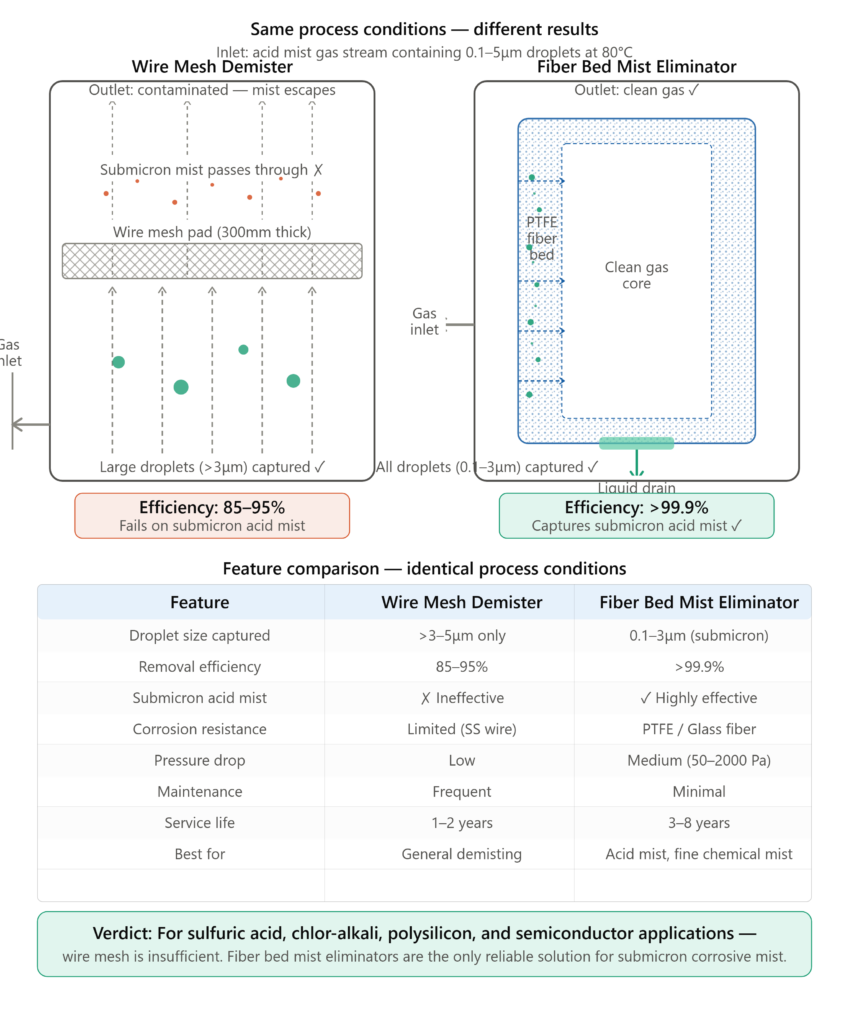
Conventional wire mesh demisters capture droplets larger than 3–5μm but fail against the submicron acid mist (0.1–3μm) generated in sulfuric acid absorption towers, chlor-alkali electrolysis cells, and polysilicon chemical vapor deposition reactors.
Fibre-bed mist eliminators solve this problem by directing the gas to flow radially through a packing bed composed of fine polytetrafluoroethylene (PTFE) or specialised glass fibres. Three mechanisms of action are at work simultaneously:
-Inertial Impaction — captures larger droplets (>1μm)
-Direct Interception — captures medium droplets (0.3–1μm)
-Brownian Diffusion — captures submicron particles (<0.3μm) The result: >99.96% collection efficiency, even for the most challenging
corrosive mist streams. Captured liquid coalesces on the fibers and
drains by gravity — no moving parts, no electricity, no consumables.
Applications & Industries We Serve (Sulfuric Acid, Chlor-Alkali & Phosphoric Acid
Every fiber bed mist eliminator we build is custom-engineered
for the specific gas composition, temperature, and flow conditions
of your process.
Sulfuric Acid Mist Eliminator
⚗️
Sulfuric Acid Plants
Removes H₂SO₄ mist from drying towers and absorption towers. PTFE fiber construction withstands concentrated sulfuric acid at temperatures up to 120°C. Meets emission standards <5 mg/Nm³.
✅Highly corrosive — PTFE/glass fiber construction
✅High concentration acid mist <3μm
✅High gas velocity tolerance
Chlor Alkali Mist Eliminator
🧪
Chlor-Alkali Industryts
Captures chlorine and caustic mist from electrolysis cells and evaporators. Resistant to wet chlorine gas and sodium hydroxide environments. Protects downstream compressors and heat exchangers.
✅Cl₂ & NaOH dual-environment resistance
✅Electrolytic cell off-gas handling
✅Continuous operation requirements
Polysilicon Mist Eliminator
💎
Polysilicon Manufacturing
Removes SiCl₄ and HCl mist from chemical vapor deposition and hydrochlorination reactors. High-purity PTFE fiber prevents contamination of semiconductor-grade polysilicon product.
✅Ultra-high purity requirements
✅Mixed silicon chloride compounds
✅High temperature gas streams
Semiconductor Mist Eliminator
🔬
Semiconductor Industry
Ultra-clean filtration for HF, HCl, and mixed acid mist in wet etching and cleaning processes. Zero particle shedding fiber construction meets semiconductor cleanroom standards.
✅Sub-0.3μm particle capture
✅HF, HCl, H₂SO₄ mixed vapors
✅Cleanroom-compatible materials
Phosphoric Acid Mist Eliminator
🌿
Phosphoric Acid Plants
Controls phosphoric acid mist generated by the reaction vessel and concentrator evaporator. Constructed with glass fiber and polytetrafluoroethylene (PTFE), it can handle H₃PO₄ concentrations up to 85%.
✅H₃PO₄ + HF combined attack
✅High solids content in gas stream
✅Environmental emission compliance
Petrochemical Mist Eliminator
🏭
Petrochemical Industry
Removes oil mist, amine mist, and hydrocarbon droplets from gas treatment, amine scrubbing, and sulfur recovery units. Custom fiber grades matched to hydrocarbon environments.
✅Hydrocarbon & amine service
✅High pressure vessel integration
✅API & ASME standards compliance
Our Fiber Bed Mist Eliminator Products
Standard Fiber Bed Mist Eliminator
Our core product: the vertical fibre-bed mist eliminator, fitted with PTFE or special glass fibre filter elements.
Shell materials: PP, FRP, 304SS, 316L SS.
Specifications:
-Fiber Diameter: 6μm/25μm
-Operating Temperature: -20°C to 150°C
Efficiency: For sub-micrometre droplets smaller than 1 μm, the capture efficiency can reach 99.96 per cent
Custom sizes: diameter 200mm to 6000mm
High-Temperature Series
Designed specifically for gas flows with temperatures up to 250°C. Features a layer of special glass fibre or PTFE fibre, with an outer casing made of stainless steel or Hastelloy C.
Applications: Sulphuric acid drying towers, first and second absorption towers, dry and wet chlorine gas in the chlor-alkali process, hydrogen mist, nitric acid mist, high-temperature hydrocarbon mist, etc.
Corrosion-Resistant Series
Offers exceptional chemical resistance in the most corrosive environments. Manufactured using our specialised glass fibre, carbon fibre or PTFE structures—including fibres, support mesh and drainage systems. Withstands hydrofluoric acid, mixed acids and highly oxidative environments.
Applications: HF alkylation, mixed acid pickling lines, semiconductor wet processes.
How We Work: From Your Process Data to Delivered Solution
From initial gas stream analysis to final global installation, Filtearth delivers precision-engineered fiber bed mist eliminators tailored to your exact process parameters. Our streamlined 4-step engineering workflow ensures maximum collection efficiency and zero operational downtime.
Step 1: Submit Your Process Data
Share your gas flow rate, temperature, pressure, mist composition, and emission targets. Our engineers review within 24 hours.
Step 2: Custom Engineering Design
We size the fiber bed element, select fiber grade and shell material, and calculate pressure drop for your specific operating conditions. No off-the-shelf guessing.
Step 3:Precision Manufacturing
We manufacture strictly in accordance with the Chinese ISO 9001 standard. Every component undergoes pressure testing and a visual inspection prior to dispatch. Lead time: 4–8 weeks, depending on dimensions.
Step 4: Global Delivery and After-Sales Service
We offer a global delivery service or can work with your freight forwarder in China, and include comprehensive installation instructions with every shipment. Our engineers will provide commissioning guidance and lifetime technical support.
🔬The process of capturing submicron mist particles using a fiber bed mist eliminator
Why Engineers and Plant Managers Choose Filtearth
🏆14+ Years of Focused Expertise
We manufacture only fiber bed mist eliminators — not a general filtration catalog. This focus means deeper expertise in corrosive mist applications than any general-purpose supplier.
📐 Truly Custom Engineering
Every unit is engineered from your actual process data. We calculate fiber diameter, packing density, bed thickness, and velocity — not copy a standard size.
🔰 ISO 9001 Certified Quality
Our manufacturing facility holds ISO 9001 certification. Every fiber bed element undergoes pressure testing, dimensional inspection, and documentation before shipment.
🧪Fiber Grade Selection Expertise
We stock and supply our own proprietary range of speciality glass fibres, carbon fibres and PTFE – we can match the right fibres to your specific chemical environment.
📊 Proven Performance Data
Our proprietary fiber bed technology achieves >99.96% mist removal efficiency — verified in operating plants across 6 continents and 20+ industries.
📞Responsive Technical Support
Direct access to the engineers who designed your unit. We respond to technical queries within 24 hours and provide lifetime operational support.
Rigorous Quality Control & Factory Pressure Testing
1.100% Factory Pressure Testing:Each finished element undergoes physical pressure drop verification prior to shipment.
2.Traceable Raw Materials:Mill test certificates supplied for all structural alloys, FRP resins, and fiber media.
3.ISO 9001 Certified Production:Fully compliant with international engineering audit standards.
⚙️Watch the manufacturing process of Filtearth Fiber Bed Mist Eliminators.
In this video, you can see how our high performance Fiber Bed Mist Eliminators are produced through precision fiber winding technology, ensuring excellent liquid mist removal efficiency, low pressure drop, and long service life.
Our Fiber Bed Mist Eliminators are engineered to effectively capture fine acid mist, oil mist, and liquid aerosols, helping industries improve emission control and equipment protection.
With professional manufacturing experience, advanced production technology, and strict quality control, Filtearth provides reliable mist elimination solutions for global industrial customers
📈Fiber Bed Mist Eliminator Manufacturing Process Factory Pressure Drop Test
In this video, we demonstrate the factory pressure drop test of our Fiber Bed Mist Eliminator to verify its airflow performance and ensure reliable operation in industrial applications.
Pressure drop is a critical parameter that affects:
✅System energy consumption
✅ Gas flow performance
✅Equipment operating efficiency
✅ Long-term reliability
Filtearth is committed to providing reliable mist elimination solutions with consistent quality and engineering support.
What Our Clients Say
🇸🇦 Saudi Arabia
⭐⭐⭐⭐⭐
Sulfuric Acid Plant
“Filtearth provided a customized fiber bed mist eliminator solution for our sulfuric acid process. The system improved acid mist control and helped protect downstream equipment under continuous operation.”
— Plant Engineering Team
Application: Sulfuric Acid / Tail Gas Treatment
🇦🇪 UAE
⭐⭐⭐⭐⭐
Chlor-Alkali Plant
“Filtearth’s fiber bed mist eliminator replaced traditional mesh demisters and delivered better fine mist removal performance, improving equipment protection and operational reliability.”
— Process Engineering Team
Application: Chemical Process Gas Treatment
🇮🇳 India
⭐⭐⭐⭐⭐
Fertilizer Manufacturer
“Filtearth supported our project with professional technical recommendations and customized design. The mist eliminator has been running reliably in our fertilizer production process.”
— Engineering Department
Application: Phosphoric Acid / Fertilizer Industry
Frequently Asked Questions About Fiber Bed Mist Eliminators
Resolve Acid Mist Compliance & Corrosion Issues
Resolve Acid Mist Compliance & Corrosion IssuesIs your factory failing to meet standards for acid mist capture and exhaust emissions? Is downstream equipment being corroded by acid mist, affecting product quality? Is the power consumption of the fans too high?
As a manufacturer specialising in fibre-bed mist eliminators for the capture of various types of chemical acid mists, Filtearth can provide bespoke engineering solutions within 24 hours.
Please contact our fibre-bed mist eliminator manufacturing team immediately, explaining the issue you are experiencing and providing your process data—gas flow rate, temperature and emission targets.